Using your phone in Hawaii requires a device that supports the specific 4G LTE and 5G frequency bands used across the islands. Since older 3G networks have been decommissioned, your smartphone must be compatible with VoLTE for standard voice calls. Verifying these technical specifications and understanding local SIM or eSIM options ensures your device maintains a stable connection.
Will My Cell Phone Work in Hawaii?
Yes, your cell phone will work in Hawaii if it is unlocked and supports the mobile frequencies used by major U.S. carriers. The islands utilize the same network technologies as the mainland United States, primarily 4G LTE and 5G. Most modern smartphones are compatible, specifically those that support LTE bands such as 2, 4, 12, 13, 25, and 66, or 5G bands like n41, n71, n258, n260, and n261. [1]
If your phone is locked to a specific carrier outside of the U.S. or does not support these frequency bands, you may experience limited service or a total lack of signal.
To maintain connectivity, ensure your device can accept a local SIM card or eSIM. While signal strength is robust in urban centers and popular tourist destinations, verifying your phone’s technical specifications before your trip is necessary to confirm compatibility with Hawaii's specific infrastructure.
1. Mobile Coverage Varies by Island
While mobile service in Hawaii is generally reliable, coverage depends on the specific island and terrain. Urban centers and coastal tourist hubs offer consistent 4G LTE and 5G access. However, remote volcanic regions, deep valleys, and high-altitude areas like Haleakala or Mauna Kea often experience weak or nonexistent signals.
Honolulu and resort areas on Oahu provide the most extensive coverage across all major frequency bands.
Signal strength often decreases in rural parts of Kauai, the Big Island, and the interior of Maui due to geographical obstructions.
Checking coverage maps from local service providers or third-party platforms is recommended for those traveling to remote hiking trails or secluded beaches.
2. Your Phone Must Be Unlocked to Use Local Services
If your phone is locked to a specific carrier, it will not accept a SIM card or eSIM from a different provider, even if the device is technically compatible with Hawaiian network frequencies. This restriction prevents access to local mobile services. Ensuring your device is fully unlocked before arrival is necessary to use local connectivity options.
iPhone users can check this by going to Settings > General > About > Carrier Lock. [2]
Android users can test compatibility by inserting a SIM card from a different network; a successful signal connection indicates an unlocked device.
Per FCC regulations, carriers are required to unlock mobile phones upon request once all contractual and payment obligations are met.
3. Availability of Public and Private Wi-Fi
Public Wi-Fi is accessible in high-traffic locations across Hawaii, including international airports, major shopping centers, and most hotel lobbies. Utilizing these networks is a practical way to manage data consumption or maintain connectivity in areas where cellular signals are obstructed by the island’s topography.
Secure, password-protected networks should be prioritized over open public hotspots to protect personal data.
Using a VPN is recommended when accessing sensitive accounts or performing financial transactions on unsecured networks.
Many resorts and upscale cafes provide high-speed fiber-optic Wi-Fi, though some establishments may require a daily access fee or customer login.
4. Check Your Phone’s Compatibility with Hawaii’s Network Bands
Mobile devices manufactured for international markets may lack support for the specific frequency bands used by carriers in Hawaii. To ensure your phone maintains a high-speed data connection, it must be compatible with the North American LTE and 5G spectrum.
According to technical specifications, the following bands are primarily used across the islands:
4G LTE: Bands 2 (1900 MHz), 4 (1700/2100 MHz), 12 (700 MHz), and 71 (600 MHz).
5G: Bands n41 (2.5 GHz), n71 (600 MHz), and high-frequency mmWave bands like n260 and n261 in dense urban areas.
If a device does not support these specific bands, it may result in significantly slower data speeds or a complete inability to register on the network. For the most reliable service, especially in rural or coastal areas, verify that your specific model supports Band 71, which is essential for long-range coverage in the Hawaiian Islands.
How Do I Know if My Phone Will Work in Hawaii?
Before traveling, verifying that your mobile device will function correctly in Hawaii is essential. While the islands share the same cellular infrastructure as the mainland United States, your phone must meet specific technical requirements regarding carrier status, network types, and frequency bands.
Carrier Restrictions
If your phone is locked to a specific mobile provider outside the United States, it will not accept a local SIM card or eSIM.
Unlocking your device is a prerequisite for using local Hawaiian mobile services or international roaming profiles.
You can verify your phone’s lock status within the device settings or by contacting your original service provider directly.
Network Compatibility
Hawaii utilizes GSM-based technologies, primarily 4G LTE and an expanding 5G network footprint.
Most modern smartphones manufactured for the North American, European, and Asian markets support these global standards.
It is necessary to confirm that your specific device model is designed to operate on these high-speed network types.
Frequency Bands
Reliable connectivity in Hawaii depends on your phone’s ability to support specific LTE and 5G bands used by local towers.
A lack of compatibility with local bands, such as Band 71 for rural areas, may result in degraded data speeds or total loss of service.
Technical specifications regarding supported bands can be found on your manufacturer’s official website or through trusted technology database platforms.
Common Mobile Frequency Bands in Hawaii
The following table outlines the primary mobile frequency bands utilized across the Hawaiian Islands. Devices that support at least one primary LTE band and one 5G band listed below are generally compatible with Hawaii's local networks.
Network Type | Frequency | Use Case |
LTE Band 2 | 1900 MHz | Core 4G capacity in urban centers and resorts |
LTE Band 4/66 | 1700/2100 MHz | High-speed data and expanded network capacity |
LTE Band 12/13 | 700 MHz | Essential for signal penetration in buildings |
LTE Band 71 | 600 MHz | Primary band for extended rural and coastal coverage |
5G n41 | 2500 MHz | Mid-band 5G for high-speed performance |
5G n71 | 600 MHz | Low-band 5G providing long-range signal reach |
5G n260/n261 | 39 GHz / 28 GHz | Ultra-fast mmWave 5G in dense areas like Waikiki |
These bands are critical if you intend to rely on mobile data for GPS navigation, streaming, or local communication. To ensure optimal connectivity throughout your stay, verify that your phone's hardware supports at least the 600 MHz (Band 71) and 1900 MHz (Band 2) frequencies, which are the backbone of coverage in Hawaii.
Cell Service in Hawaii
Cellular service across the Hawaiian Islands is integrated into the domestic United States network infrastructure. The region is served by the three major national carriers Verizon, T-Mobile, and AT&T. These providers offer extensive 4G LTE coverage and 5G layers across the islands. Because Hawaii is a U.S. state, travelers from the mainland typically utilize their existing plans without international roaming charges.
Does Verizon work in Hawaii?
Yes, Verizon provides comprehensive coverage throughout Hawaii. The carrier offers 4G LTE and 5G service including 5G Ultra Wideband in select locations. Coverage is available in major cities like Honolulu and Hilo, though signal strength depends on local topography, wireless equipment, and weather conditions.
Does T-Mobile work in Hawaii?
Yes, T-Mobile provides extensive 4G LTE and 5G coverage across the islands. The carrier maintains a broad 5G network that includes high speed data in many areas. T-Mobile also offers T-Satellite service which covers Hawaii and allows for connectivity in outdoor locations where traditional signals are limited.
Does AT&T work in Hawaii?
Yes, AT&T provides wireless voice and data network coverage across the state of Hawaii. The carrier has implemented specialized coverage like Band 14 on over 200 sites across the state to support public safety communications. AT&T 5G is available in Hawaii with localized performance in high traffic areas such as Daniel K. Inouye International Airport.
Hawaii Phone Code and Dialing
Hawaii is part of the North American Numbering Plan. This ensures its telecommunications format matches the rest of the United States.
Country Code: The country code for Hawaii is +1.
Area Code: The entire state uses the 808 area code.
Mandatory 10-Digit Dialing: All local calls within Hawaii require dialing the full 10 digits consisting of the 808 area code and the telephone number. [3]
International Dialing: To call Hawaii from outside the United States, dial the international exit code of the originating country followed by 1, the 808 area code, and the 7-digit local number.
Roamless eSIM for Hawaii
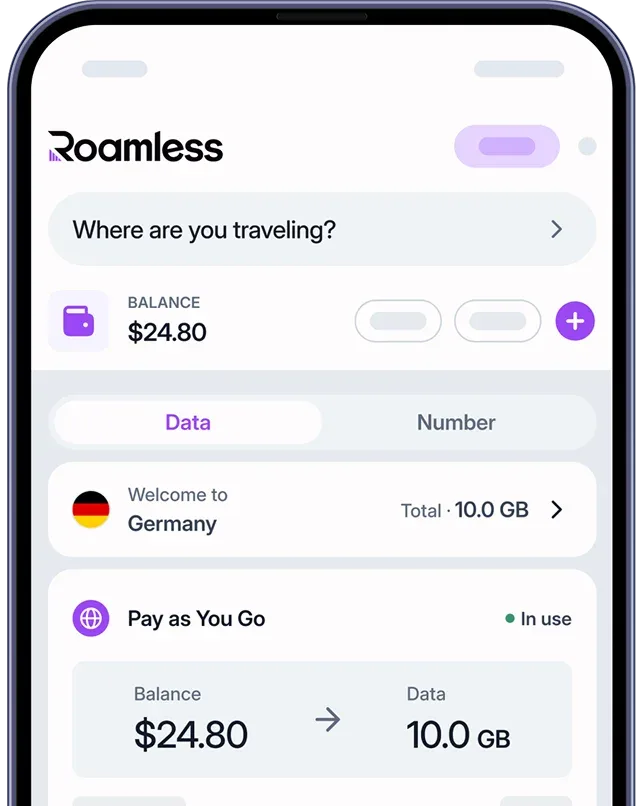
Using a global eSIM is a practical way to maintain mobile data connectivity during your stay in Hawaii. This technology allows travelers to activate a data plan directly on their smartphone without requiring a physical SIM card. The activation process is managed through a QR code, eliminating the need for local store visits or hardware swaps.
Global eSIM providers offer flexible pricing models with various data increments. You can find plans starting with 1 GB for $3.95, or select larger volume options such as 3 GB for $8.95, 5 GB for $13.95, and 10 GB for $19.95. These plans are designed for temporary use and do not involve long-term contracts, allowing you to track your remaining balance easily through a dedicated mobile application.
Key features of using a Roamless eSIM in Hawaii:
Usage-Based Pricing: You pay only for the data volume you select.
Instant Activation: Data service is enabled immediately via QR code scanning.
Encrypted Connection: Provides a private data tunnel without relying on unsecured public Wi-Fi.
A single eSIM profile: Works across all Hawaiian Islands and the U.S. mainland.
In addition, you can open the Roamless app and enter a valid promo code at checkout. To get the latest offers and extra data on your first purchase, visit our eSIM promo code page.
Roamless offers a streamlined data solution for Hawaii travelers, eliminating the need for physical SIM cards or carrier switching. To learn more, check out our eSIM Hawaii page.
Frequently Asked Questions
Can I Use My Phone in Hawaii?
Yes, your phone will work if it is unlocked and supports North American frequencies. The islands use standard 4G LTE and 5G technologies. For full connectivity, verify support for LTE bands 2, 4, 12, and 71 or 5G band n71.
Can I use a foreign SIM card in Hawaii?
Yes, but international roaming charges are typically very high. To avoid excessive fees, using a local eSIM or a prepaid SIM card is recommended for domestic data rates.
Do I need to register my SIM card in Hawaii?
No, there is no legal requirement to register prepaid SIM cards with a passport in Hawaii. You can purchase and activate them immediately. Only post-paid monthly contracts require a credit check and personal identification.
Sources:
[1] GSMArena. (n.d.). Network bands in United States. Retrieved from https://www.gsmarena.com/network-bands.php3?sCountry=United+States
[2] Apple Inc. (2024). How to unlock your iPhone for use with a different carrier
[3] Hawaii Public Utilities Commission. (2021). Mandatory 10-digit dialing for the 808 area code. https://puc.hawaii.gov/telecommunications/10-digit-dialing/