The World Cup 2026 will take place across three countries, the United States, Canada, and Mexico, with matches hosted in multiple cities and frequent cross-border travel expected for many fans. Moving between destinations during a short tournament period makes mobile connectivity an important part of the overall travel plan. From accessing digital tickets and navigation apps to managing bookings and communication, travelers will rely heavily on their phones. This post compares physical SIM cards and eSIMs to determine which option is better suited for the World Cup 2026.

SIM vs eSIM: What is the Difference?
A physical SIM card is a removable chip inserted into a phone to connect to a mobile network, while an eSIM is embedded directly into the device and activated digitally. With a physical SIM, changing plans often requires replacing the card, especially when traveling between countries. An eSIM allows mobile plans to be added or switched without physically swapping anything. The table below shows the key differences between a physical SIM and an eSIM:
Feature | Physical SIM | eSIM |
|---|---|---|
Format | Removable plastic card | Embedded digital SIM |
Activation | Insert SIM card manually | QR code or manual activation |
Switching plans | Requires physical SIM replacement | Can switch digitally |
Multi-country support | Usually country-based | Regional or global plans available |
Device compatibility | Works on all phones | Requires eSIM-compatible device |
Table 1: Overall SIM vs eSIM Comparison
For more information, you can check out our post on eSIM vs Physical SIM.
Choosing Between a Physical SIM and an eSIM for the World Cup 2026 Trip
Traveling during the World Cup 2026 may involve visiting one country or moving between the United States, Canada, and Mexico within a short period. The right SIM option depends on how the trip is structured and how mobile services will be used.
A Physical SIM: Can be suitable for devices that do not support eSIM or for travelers staying in a single country for the entire tournament. However, visiting more than one country may require purchasing and replacing a new SIM card in each destination.
An eSIM: Can work for both single-country and multi-country travel. Destination-based plans can be used for one host country, while regional or global plans may simplify travel between multiple countries. Activation and plan management are handled digitally without physically replacing a SIM card.
SIM vs eSIM: Signal Strength and Speed
Signal strength and internet speed do not depend on whether a physical SIM or an eSIM is used. Both technologies provide the same network performance when connected to the same mobile carrier. Coverage quality in the United States, Canada, or Mexico is determined by local network infrastructure, and access to 4G or 5G speeds depends on device compatibility and carrier support rather than the SIM format itself.
Note: Please check the coverage of the local carrier in the host country before choosing a mobile plan.
For more information, you can read our guide on Does eSIM Support 5G.
SIM vs eSIM: Cost and Pricing Flexibility
Cost can play an important role when choosing between a physical SIM and an eSIM during the World Cup 2026, especially for international travelers visiting more than one country within a short period.
A Physical SIM: Purchasing a local SIM card in one country usually provides domestic rates for that destination. However, using a home-country SIM abroad may result in roaming charges, and visiting multiple countries can require buying separate SIM cards in each location.
An eSIM: Travel eSIM plans can include destination-based, regional, or global options, allowing travelers to select a plan that matches their itinerary. Compared to traditional roaming, these plans are often more cost-efficient and offer more predictable costs per GB. Because plans are activated digitally, switching or adjusting plans does not require physically replacing a SIM card.
Using a Physical SIM During the World Cup 2026 Trip
A physical SIM card may be a familiar option for many travelers, especially those using devices that do not support eSIM. It connects directly to a local carrier once inserted into the device and activated.
Advantages: Compatible with most phones and widely available from local carriers in the United States, Canada, or Mexico. It provides domestic rates within the country where it is activated.
Disadvantages: Using a home-country SIM abroad may result in roaming charges. Traveling between multiple host countries can require purchasing and replacing separate SIM cards in each destination. Physical handling is required for insertion and removal, and losing or damaging the SIM card can interrupt service. Replacing a SIM card may also temporarily disconnect access to the primary number stored on the device.
For more information, you can check out our post on How to Avoid Roaming Charges.
Using an eSIM During the World Cup 2026 Trip
An eSIM is embedded directly into the device and activated digitally, without requiring a physical card. For travelers attending the World Cup 2026, this can make plan setup and management more flexible, especially when moving between cities or countries during the tournament.
Advantages: Can be activated digitally through a QR code or directly in an app, without visiting a physical store. Setup can be completed before departure or upon arrival. Supports destination-based, regional, or global plans depending on travel needs. Allows users to add or switch plans without physically replacing a SIM card. Reduces the risk of losing or damaging a physical SIM card. Makes it possible to keep a primary SIM active while using a separate travel plan on compatible devices.
Disadvantages: Requires an eSIM-compatible device. Initial setup requires internet access for activation.
For more information, you can check out our post on Top Benefits of Using an eSIM.
SIM vs eSIM for Multi-Country Travel During the World Cup 2026
Traveling between the United States, Canada, and Mexico during the World Cup 2026 can involve short stays and movement from one country to another. In this multi-country setting, managing mobile connectivity across destinations becomes an important factor when comparing a physical SIM and an eSIM.
Scenario | Physical SIM | eSIM |
|---|---|---|
Visiting more than one host country | May require a new SIM card in each country | One regional or global plan can cover multiple countries |
Setup timing | Usually purchased and activated after arrival | Can be installed before departure and activated digitally |
Keeping primary number active | Requires SIM replacement | Can use dual SIM functionality on compatible devices |
Risk of physical loss or damage | SIM card can be lost or damaged | Less risk of physical loss or damage since there is no removable card |
Table 2: SIM vs eSIM Comparison for Multi-Country Travel During the World Cup 2026
For more information, you can check out our post on How to Plan a Multi-Country Trip.
Which One is Better for the World Cup 2026: SIM or eSIM?
For the World Cup 2026, a global eSIM is the more practical option, especially for international visitors traveling between the United States, Canada, and Mexico. Digital activation allows plans to be installed before departure or upon arrival without visiting a physical store, and there is no need to insert or replace a SIM card when moving between countries. Regional and global plan options can simplify multi-country travel under a single plan, while dual SIM functionality on compatible devices makes it possible to keep a primary number active. Because plan management is handled digitally, adjusting or switching plans can be done more easily during a busy tournament schedule, making eSIM a more flexible solution compared to a physical SIM in this context.
Why Roamless eSIM is Better Than a Physical SIM for the World Cup 2026 Trip?
Roamless eSIM is better suited for the World Cup 2026 because it combines flexible plan structures, digital activation, and multi-country coverage in a way that reduces the need for physical SIM replacement when traveling between the United States, Canada, and Mexico.
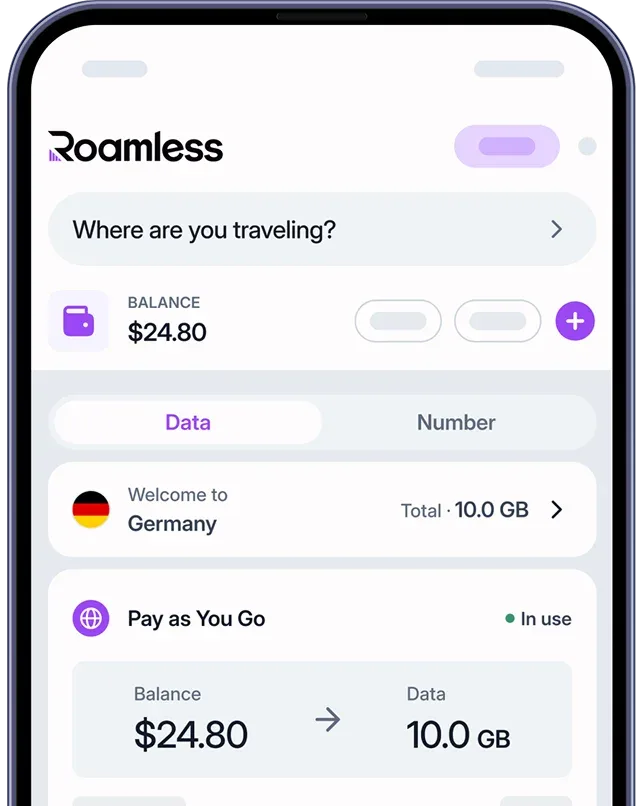
Flexible Plan Options: Roamless eSIM includes country-based fixed plans for each host country that are valid for 30 days, as well as a North America regional plan that also remains valid for 30 days and covers all three countries under one plan. Roamless also has globally valid pay-as-you-go options with no expiration, allowing unused balance to be used on a future trip.
No Traditional Roaming Charges: When using Roamless eSIM instead of a home-country physical SIM abroad, mobile data is provided through dedicated travel plans rather than standard roaming structures, which can help avoid typical roaming fees during the tournament.
Digital Activation Without Store Visits: Roamless eSIM can be activated through a QR code or directly in the app, without purchasing or inserting a physical SIM card upon arrival.
Keep Your Primary Number Active: On compatible devices, Roamless eSIM can be used alongside a primary SIM, allowing travelers to keep their main number active while using a separate travel data plan.
Compatible with Most Modern Mobile Devices: Roamless eSIM works on most recent iOS and Android smartphones and many tablets that support eSIM technology.
Frequently Asked Questions
Do I need to replace my SIM card when moving between countries during the World Cup 2026?
With a physical SIM, you may need to replace the card when moving between countries. An eSIM can be managed digitally without swapping SIM cards, which is especially practical for multi-country travel.
Can I use both a physical SIM and an eSIM at the same time during the World Cup 2026?
Yes, many modern smartphones support dual SIM functionality, allowing you to use both a physical SIM and an eSIM at the same time. This can be useful for managing multiple phone numbers or data plans during your trip. For more information, you can read our post on Can I use eSIM and physical SIM at the same time.
Which one consumes more battery: eSIM or a physical SIM card?
There is no significant difference in battery consumption between an eSIM and a physical SIM card. Battery usage depends more on signal strength, network conditions, and device usage than on the SIM format itself. For more information, you can read our post on Does eSIM Use More Battery.
Is Roamless eSIM compatible with all smartphones?
Roamless eSIM works on most recent iOS and Android smartphones and many tablets that support eSIM technology. It is important to confirm that your device supports eSIM before purchasing a plan. For more information, you can check out our posts on eSIM Compatible iPhones, eSIM Compatible Samsung Phones, eSIM Compatible Tablets.
How do I activate my Roamless eSIM before the World Cup 2026?
Roamless eSIM can be activated digitally by scanning a QR code or through the app. Activation can be completed before departure or upon arrival at your destination.