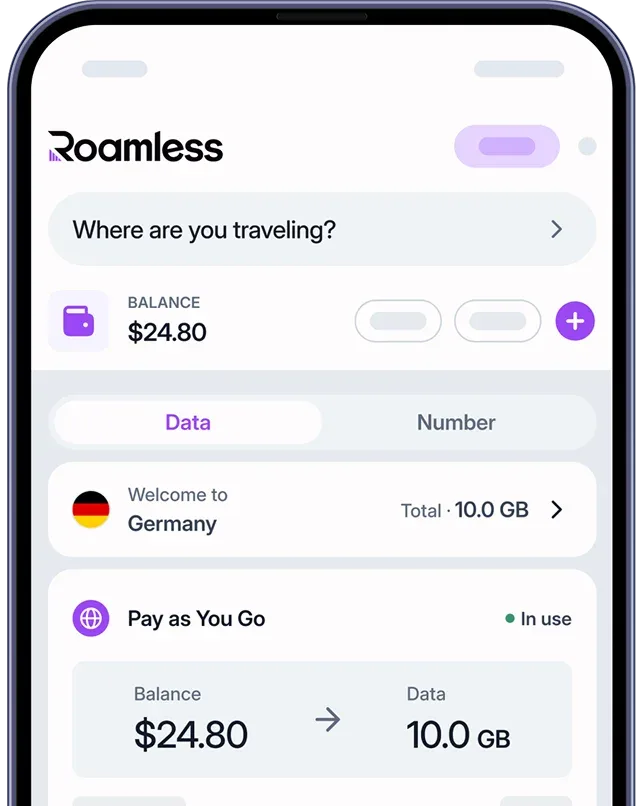
Apple Music’s mobile data usage mainly depends on how long you listen and which audio quality settings you use. Lower quality uses relatively little data, while higher-quality options can increase data usage quickly. On average, Apple Music can use anywhere from about 30 MB per hour to over 1.5 GB per hour, depending on the selected audio settings. If you plan to use Apple Music while traveling abroad, a global eSIM like Roamless can help you track and manage your mobile data more easily.
How Much Data Does Apple Music Use?
Apple Music typically uses between 0.5 MB and 30 MB per minute, or roughly 30 MB to over 1.5 GB per hour, depending on the selected audio quality. Listening at lower quality consumes much less data, while higher-quality audio provides better sound but can use a large amount of data in a short time. The table below shows estimated Apple Music data usage per minute and per hour across different audio quality levels:
Audio quality level | Data per minute | Data per hour |
|---|---|---|
Low audio quality | ~0.5–0.7 MB | ~30–40 MB |
Standard audio quality | ~2–2.5 MB | ~120–150 MB |
Very high audio quality | ~12–13 MB | ~700–800 MB |
Highest audio quality available | ~25–30 MB | 1.5 GB+ |
Table 1: Estimated Apple Music Data Usage by Audio Quality Settings
Note: Higher audio quality settings deliver better sound but significantly increase data usage. Background activity such as album artwork loading and automatic buffering can also slightly raise data consumption.
Disclaimer: Data usage values are estimates and may vary depending on your device, network conditions, audio quality settings, app version, and listening habits. For the most accurate information, check Apple Music’s mobile data usage in your device settings.
How to Check Apple Music Data Usage on Your Device
Monitoring your Apple Music data usage helps you understand how much mobile data the app consumes, especially if you listen frequently or use higher audio quality settings. Since Apple Music does not show detailed data usage inside the app, you can check this information directly from your device settings.
On iPhone Devices:
Open the Settings app.
Tap Cellular or Mobile Data.
Scroll down to find Apple Music in the list of apps.
The amount shown represents how much mobile data Apple Music has used during the current statistics period.
Open the Settings app.
Tap Apps or Applications.
Find and select Apple Music from the list.
Tap Data usage or Mobile Data & Wi-Fi.
Here, you can see how much mobile data Apple Music has consumed over a selected time range.
On Android Devices:
How to Reduce Apple Music Data Usage
Apple Music’s data usage can increase quickly at higher audio quality levels, but adjusting a few key settings can help keep mobile data consumption under control:
Lower Audio Quality for Mobile Data: Reducing the audio quality setting lowers how much data Apple Music uses per minute and per hour, making it the most effective way to control data usage.
Disable Downloads Over Mobile Data: Turning off downloads over mobile data ensures songs are only downloaded when you explicitly allow it and at a selected download quality, helping avoid unexpected data usage.
Turn Off Background App Refresh: Disabling background app refresh for Apple Music prevents the app from using mobile data in the background for tasks such as refreshing content or loading artwork.
Enable Low Data Mode: Activating low data mode limits background activity at the system level and helps reduce overall mobile data usage while listening.
For more information, you can also read our posts on What is Background App Refresh and What is Low Data Mode on iPhone.
Comparing Apple Music’s Data Usage with Other Music Streaming Platforms
At standard audio quality, most music streaming apps use similar amounts of mobile data, with small differences between platforms. Apple Music typically uses around 120–150 MB per hour, while Spotify, Deezer, and Amazon Music usually fall slightly below this range. SoundCloud and Pandora tend to use less data due to lower average bitrates and different content formats. The table below compares estimated data usage per minute and per hour at standard audio quality across popular music streaming services:
Music Streaming Platforms | Data usage per minute (standard quality) | Data usage per hour (standard quality) |
|---|---|---|
Apple Music | ~2–2.5 MB | ~120–150 MB |
Spotify | ~1.8–2.2 MB | ~110–130 MB |
Deezer | ~1.7–2 MB | ~100–120 MB |
YouTube Music | ~1.5–2 MB | ~90–120 MB |
Amazon Music | ~1.6–2 MB | ~95–120 MB |
TIDAL | ~2–2.3 MB | ~120–140 MB |
SoundCloud | ~1.2–1.6 MB | ~70–95 MB |
Pandora | ~1–1.4 MB | ~60–85 MB |
Table 2: Estimated Data Usage at Standard Audio Quality for Popular Music Streaming Services
Note: This comparison is based on each platform’s standard audio quality settings; data usage can be significantly lower when default or data-saving quality options are used.
Disclaimer: Data usage figures are estimates and may vary depending on device type, network conditions, app version, and individual listening habits. Actual data consumption can differ based on the exact settings used within each service.
For more information, you can also read our post on How Much Data Does Spotify Use.
Using Apple Music with Roamless eSIM Abroad
Listening to Apple Music while traveling can increase mobile data usage, especially when using higher audio quality settings or listening for extended periods on mobile data. A global eSIM like Roamless can help you manage your mobile data more effectively while using Apple Music abroad:
Wide global coverage: Roamless provides mobile data service in over 200 destinations, allowing you to keep listening to Apple Music without relying on local SIM cards or public Wi-Fi.
High-speed mobile connectivity: With support for fast mobile data speeds, including 5G where available, Roamless allows songs to load more quickly and helps maintain a stable listening experience while using Apple Music on the go.
Unlimited hotspot support: Roamless includes unlimited hotspot sharing, making it possible to listen to Apple Music across multiple devices when needed.
Multiple device compatibility: Roamless works on both iOS and Android devices, so you can use Apple Music seamlessly across different phones without changing a physical SIM card.
In-app data tracking feature: Roamless lets you view and monitor your mobile data usage in real time directly from the app, helping you better understand and control how much data Apple Music uses while traveling.
For more information, you can also check out our post on How Much Data Does Streaming Use.
Frequently Asked Questions
Does Apple Music use a lot of data?
Apple Music does not necessarily use a lot of data at lower or standard audio quality, but data usage can increase quickly at higher audio quality levels. Depending on the selected settings, Apple Music can use anywhere from around 30 MB per hour to over 1.5 GB per hour.
How much data does Apple Music use per hour?
At standard audio quality, Apple Music typically uses about 120–150 MB per hour [1]. Lower quality settings use much less data, while very high or highest audio quality settings can consume significantly more data in the same amount of time.
Does Apple Music use data in the background?
Apple Music can use a small amount of mobile data in the background for tasks such as buffering, updating artwork, or refreshing content. This can be limited by turning off background app refresh or enabling low data mode [2].
Does downloading music reduce data usage on Apple Music?
Yes. Downloading songs allows you to listen offline without using mobile data during playback [3]. However, downloading over mobile data can use a significant amount of data unless it is restricted or carefully managed.
Which app uses the least data: Apple Music or Spotify?
At standard audio quality, Spotify usually uses slightly less data than Apple Music. Spotify typically consumes around 110–130 MB per hour, while Apple Music averages about 120–150 MB per hour at similar quality levels.
Sources:
[1] Apple Community. ''How much data does Apple Music use?''. Accessed December, 2025. - https://discussions.apple.com/thread/7104730?sortBy=rank
[2] Apple Support. ''Use Low Data Mode on your iPhone and iPad''. Accessed December, 2025. - https://support.apple.com/en-us/102433
[3] Apple Support. ''Add music to iPhone and listen offline''. Accessed December, 2025. - https://support.apple.com/en-gb/guide/iphone/iph0cff2d191/ios