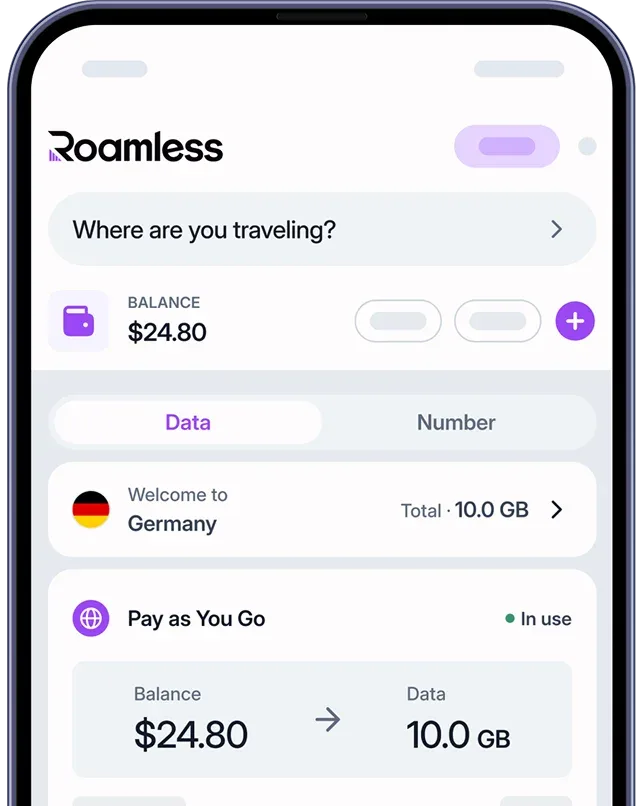
This allows users to access coverage in remote locations where network availability can be limited. A Single Global eSIM works in many regions and can be activated through the app. In some countries, it supports more than one local network, which helps maintain connectivity in rural areas.

What Is the Best eSIM for Rural Areas?
Roamless is one of the most reliable eSIM options for users in rural or remote areas. It offers pay as you go and fixed plans that do not expire quickly. Travel eSIM provides coverage in more than 200 destinations worldwide with 4G, LTE, and 5G support, which makes it suitable for travelers and residents in regions with limited mobile infrastructure. It also includes in app international calling and hotspot sharing, allowing users to stay connected in areas with limited network access. Its flexible usage model allows unused data to remain available for future use, which can help reduce service interruptions in rural locations. The table below compares Roamless with other eSIM providers based on coverage, data plans, and general usability for rural users.
eSIM Provider | Coverage | Data Plan Options | Calls and SMS | Key Features |
|---|---|---|---|---|
Roamless | 5G / LTE / 4G in 200+ destinations | Pay as you go option with no expiry and fixed plans valid for 30 days | In app calls available | Unlimited speed, hotspot and tethering support, app based management |
Ubigi | 5G / 4G in 200+ destinations | Fixed and unlimited plans with limited validity and fair use rules | Not included, requires VoIP apps | App activation, tethering supported, data only service |
Saily | 5G / 4G / LTE in 200+ destinations | Fixed and unlimited plans with limited validity, expires after validity period | Country based plans require separate activation, regional and global plans support multiple countries | Hotspot supported, in app plan management, simple activation process |
aloSIM | 5G / LTE in 200+ destinations | Prepaid country and regional plans valid for 7 to 30 days | Not included, data only | Quick setup, suitable for travel across regions |
Table 1: Comparison of eSIM Providers for Rural Areas
Disclaimer: The information provided in this table is based on publicly available data from each eSIM provider as of February 9, 2025. Coverage, plan details, and pricing may change. Users should verify the latest information directly with the providers before purchasing or activating a plan.
How to Choose the Best eSIM for Rural Areas?
Choosing the right eSIM for rural areas is important for staying connected in locations where mobile networks can be limited. A suitable eSIM can help maintain access to data without relying on physical SIM cards or local stores, especially in remote regions.
When selecting an eSIM for rural use, consider the following factors to ensure reliable connectivity outside major cities:
Network coverage: Check whether the eSIM provider works with local mobile networks that offer coverage in rural and remote areas, not only in cities.
Network availability: Look for providers that can connect to more than one local network, which can help maintain access when coverage is uneven.
Data access: Choose a plan that provides enough data for essential use such as maps, messaging, and basic browsing in low coverage areas.
Plan flexibility: Select an eSIM that allows data to remain usable over time or can be topped up without strict expiration.
Activation process: Make sure the eSIM can be activated through an app without needing physical support, which is useful in remote locations.
Device compatibility: Confirm that your device supports eSIM technology and works with the selected provider.
Customer support: Access to support can be important if connectivity issues occur in rural regions.
Connection types: Check whether the eSIM supports 4G, LTE, or 5G where available, depending on local infrastructure.
Regional usability: If traveling across different rural regions or countries, choose an eSIM that works across multiple locations without repeated installations.
Considering these points can help you select an eSIM that supports stable connectivity in rural environments and reduces the risk of losing access while traveling or living outside urban areas.
Why Roamless eSIM Stands Out for Rural Areas
Roamless eSIM offers features that make it suitable for use in rural and remote areas where network conditions can vary:
Automatic network switching: In supported countries, Roamless can connect to more than one local mobile network and switch between them to help maintain connectivity in rural or remote areas where coverage may vary.
No speed limits: Roamless does not apply speed restrictions, allowing users to access available network speeds based on local coverage.
Flexible usage model: The pay as you go structure allows users to manage data without long term commitments, which can be useful in areas with unpredictable access.
In app calling support: Roamless includes in app calling, providing an additional communication option where traditional services may be limited.
Wide regional coverage: Roamless operates across many destinations, supporting connectivity in both urban and rural locations.
Roamless Plans for Popular Rural Travel Destinations
Roamless provides flexible data access for travelers visiting rural and non urban areas. Below is an overview of how Roamless supports connectivity in countries where visitors often travel beyond major cities and into countryside regions. The focus is on coverage availability and supported local networks in rural locations.
Destination | Pay as you go Plans | Fixed Plans | Coverage | Available Networks |
|---|---|---|---|---|
France | $2.45 / 1 GB (No expiry) | Starts from 1 GB for $3.95. 5 GB for $9.95 (Valid for 30 days) | 4G 5G LTE | Bouygues Telecom, Free Mobile, SFR, Orange |
Japan | $2.45 / 1 GB (No expiry) | Starts from 1 GB for $3.95. 5 GB for $9.95 (Valid for 30 days) | 4G 5G LTE | KDDI |
New Zealand | $2.45 / 1 GB (No expiry) | Starts from 1 GB for $3.95. 5 GB for $13.95 (Valid for 30 days) | 4G 5G LTE | Spark |
Italy | $2.45 / 1 GB (No expiry) | Starts from 1 GB for $3.95. 5 GB for $10.95 (Valid for 30 days) | 4G 5G LTE | Vodafone, Wind, Iliad |
Spain | $2.45 / 1 GB (No expiry) | Starts from 1 GB for $3.95. 5 GB for $9.95 (Valid for 30 days) | 4G 5G LTE | Vodafone, Movistar, Orange, Yoigo |
Table 2: Overview of Roamless pay as you go and fixed plan support for rural travel destinations
For more information, you can visit our pages on eSIM France, eSIM Japan, eSIM New Zealand, eSIM Italy, and eSIM Spain.
How Much Data Do You Need with a Global eSIM in Rural Areas?
Users relying on a global eSIM in rural areas usually need between 1 GB and 3 GB of mobile data per day. Actual usage depends on how long you stay, how often you move between locations, and how limited local network access is. Basic activities such as navigation, messaging, emails, and light web browsing often remain close to 1 GB per day. In rural environments, data usage can increase when maps reload frequently, signals change between networks, or apps try to reconnect in low coverage areas. Activities like video streaming, cloud access, or hotspot use can raise daily data needs to 3 GB or more.
For more information, you can check out our guide on How much data do I need for travel abroad.
Why Traditional Roaming Costs More Than a Global eSIM in Rural Areas
Using traditional mobile roaming in rural areas often leads to higher and less predictable costs. In remote regions, roaming fees are commonly charged per megabyte, and prices can vary based on local network availability and agreements. Background data usage such as app updates, location services, and map loading can increase unexpectedly when signals are weak or unstable. A global eSIM connects directly to supported local networks with defined pricing, which makes data usage easier to track and manage in rural locations where consistent access can be difficult.
For more information, you can read our post on How to avoid roaming charges.
Pro Tips for Using eSIM in Rural Areas
Maintaining stable eSIM connectivity in rural regions requires basic preparation and awareness of local network conditions. The following tips highlight practical steps for using an eSIM effectively in areas with limited infrastructure:
Check network coverage before activation: Review the carrier coverage map to confirm service availability in the areas you plan to visit.
Activate your eSIM in a strong signal area: Complete the setup before entering regions where network access may be limited.
Keep multiple eSIM profiles: Using more than one provider allows switching between networks if coverage becomes weak.
Use 4G or 5G compatible devices: Newer devices support more frequency bands and perform better in rural locations.
Enable Wi Fi calling and messaging: Communication can continue through Wi Fi when mobile signals are unstable.
Monitor data usage: Unstable connections may increase background data use, so track usage through the eSIM app.
Prepare offline navigation tools: Download maps and essential information in advance in case of temporary signal loss.
Frequently Asked Questions
Can an eSIM switch networks in rural regions?
Yes, in some countries Roamless eSIM supports connections to more than one local mobile network. This allows the device to switch to the available network with stronger signal, which can help maintain connectivity in rural or remote areas where coverage may vary.
Can I use hotspot or tethering with an eSIM in rural areas?
Most eSIM compatible devices support hotspot and tethering features. This can be useful in rural areas where Wi Fi access is limited. Performance depends on local network coverage and device support.
Does an eSIM work in rural areas?
Yes, an eSIM can work in rural areas if mobile network coverage is available. Connection quality depends on local infrastructure and the networks supported by the eSIM provider.
Is eSIM coverage in rural areas different from cities?
Yes, rural coverage is often more limited than in urban areas. Some eSIM providers offer access to multiple local networks, which can help improve connectivity outside major cities.
Do I need a special eSIM plan for rural travel?
A specific rural plan is usually not required. Choosing an eSIM with wide regional coverage and flexible data usage is generally sufficient for rural travel.