TL;DR
A travel eSIM is a second SIM your phone downloads, rather than a plastic card you slot in. It still connects you through a local network’s roaming agreement. The difference is that the eSIM provider holds that agreement, and you buy data per GB, as a fixed amount or as an unlimited plan, instead of paying your carrier a daily roaming charge. On most trips longer than a night or two that works out cheaper. A travel eSIM does not come with a phone number, though, so your calls and texts keep running on your usual number while the eSIM carries the data.
What is data roaming?
Data roaming is using mobile data on another carrier's network while you're abroad. When your phone uses mobile data, it reaches the internet through nearby cell towers that are part of a mobile network, and at home that's usually your carrier's network. Abroad, the network belongs to a local carrier yours has an agreement with.
That local carrier bills your carrier a wholesale rate for every gigabyte you use, and your carrier adds its margin before passing the cost on to you. Each agreement is negotiated separately, which is why the same carrier can charge different amounts from one country to the next. Outside regional agreements like the European Union’s (EU) Roam Like at Home rules, those wholesale rates and margins are why roaming charges add up so quickly.
What does and doesn't trigger roaming charges?
Using mobile data, making or receiving calls and sending texts on a foreign network can all trigger roaming charges on your home line. Hotel and cafe WiFi doesn't count as roaming, because it doesn’t use a mobile network at all, so it won’t show up on your bill. If you turn off data roaming on your home line, you can only get online over WiFi or a travel eSIM you buy separately, but calls and texts you make or receive on a foreign network can still be charged as roaming.
You’ll usually find out what those charges are as soon as you land in a foreign country, when your carrier texts you its roaming rates. If you’re on an EU line, your carrier has to send you this text and apply a spending limit of €50 a month to any data roaming on top of your plan. UK carriers also have to send you a text with their roaming charges, but as there’s no legal spending limit, you may want to set a custom spend cap with your carrier before you travel. If you don't need to receive calls and texts and want to be certain you won't get any roaming charges, you can turn off your home line completely.
What is a travel eSIM?
A travel eSIM is a downloadable SIM profile sold by a provider with its own roaming agreements around the world. It downloads onto the eSIM chip built into your phone, so there's no plastic card to swap. You set it up before you fly, it connects to a local network when you land, and you pay the provider instead of your home carrier. Many providers sell data in fixed packages that expire after a set number of days, while others charge only for the data you use, from a balance that doesn't expire.
Is using a travel eSIM still roaming?
Yes, a travel eSIM connects to a local network through a roaming agreement too. The main difference from roaming with your home carrier is that instead of paying for a day pass, you buy data per GB, a fixed amount of data, or an unlimited plan for the number of days you need.
“Every travel eSIM is a roaming product, just like your carrier’s day pass. The difference between the two is how the cost of the data reaches you. With a travel eSIM, you pay for the data you use, while a day pass marks it up into a flat daily fee you pay whether you use the data or not.”
Asım Alp, Co-founder and CTO, Roamless (15+ years in Telecommunications)
You’re still a guest on that network, though, so speeds may drop at busy times because some networks give roaming traffic lower priority than their own customers. With automatic network selection, your eSIM joins whichever partner network has the strongest signal and stays on it as long as it has any signal. If your connection is slow and your provider has more than one network where you are, you can switch to another network manually in your phone’s settings. Before you pick a travel eSIM, check which local networks the provider uses where you’re going.
Travel eSIM vs roaming with your carrier
Home carrier roaming | Travel eSIM | |
|---|---|---|
Who holds the roaming deal | Your carrier | The eSIM provider |
How you are billed | Per day, or per megabyte without a pass | Per gigabyte, a fixed plan, or unlimited |
Unused allowance | Ends with the day or the billing month | Depends on the provider, some credit does not expire |
Your phone number | Works as normal | Not included, data only |
Calls and SMS | Included or billed per use | Not included |
Several countries on one trip | Charged per day in each | Usually one profile covers all of them |
Setup | Nothing to do, or a text to purchase | Install before you fly or when you land |
The day-pass model charges you for a whole day the moment your phone touches the network, so one map lookup during a five-hour layover costs the same as a full day of use.
How much data do you need for a trip?
Travelers on the subreddit r/eSIMs and the general travel subreddits report far lower usage than they expect when they buy. The clusters people post are around 3GB for a short city break, 5GB to 10GB for a normal week of maps, messaging and browsing, and around 20GB for two weeks in Japan including rural areas. People who stream instead of using hotel WiFi report 30GB or more per trip, and remote workers tethering a laptop all day report 50GB to 80GB a month.
If you’re unsure how much data you’ll need, or have a data-heavy trip ahead, like working remotely from somewhere with patchy WiFi, many travel eSIM providers offer unlimited plans. These usually come with a fair use limit, so you get full-speed data up to a set amount each day, then your speed drops. You can still stay connected at this lower speed and keep using maps or music streaming apps, but it won’t be enough for things like HD video.
As two people on the same trip often end up using very different amounts of data, it helps to know roughly how much data you’ll need for each activity before you compare roaming with a travel eSIM.
How much does roaming cost per day?
A day of roaming costs between about $5 and $11 depending on where your line is from, compared with $2 to $5 per gigabyte for a travel eSIM.
Home market | Carriers averaged | Average day rate | In USD | Data it buys per day | 7-day trip |
|---|---|---|---|---|---|
United States | Verizon, AT&T, T-Mobile | $11.33 | $11.33 | 2GB to 5GB at full speed, then slowed | $79.33 |
Canada | Bell, Telus, Rogers | C$14.90 | $10.73 | Your home plan’s data, 5GB before the slowdown | $75.10 |
United Kingdom | EE, O2, Three | £7.00 | $9.45 | Your home plan’s data, capped at 12GB a month on Three | $66.15 |
Australia | Telstra, Optus, Vodafone | A$6.67 | $4.67 | 1GB to 5GB depending on carrier | $32.68 |
Travel eSIM | Market range | No day charge | $2 to $5 per GB | Pay per GB, fixed data plans or unlimited | $14 to $35 |
Methodology: each figure is the mean of the three carriers’ advertised daily roaming rates for a long-haul destination outside the home region, taken from their own pricing pages in September 2026. For EE, that’s its Zone 1 24-Hour Pass at £6, which covers destinations including the US, Canada and Australia. Rogers publishes multi-day international passes rather than a flat daily rate, so its C$75 seven-day pass is counted as C$10.71 a day. Converted at the European Central Bank's reference rates for November 4, 2026: 1.35 USD to the pound, 0.70 to the Australian dollar and 0.72 to the Canadian dollar. The travel eSIM row is the typical market range per gigabyte rather than any one provider's price.
The day rate is charged whole regardless of how much you use, so the lighter your usage the worse the per-gigabyte figure gets. At 200MB on a travel day, that American average works out at more than $56 per gigabyte. Skipping the pass costs far more again, because AT&T's pay-per-use rate without one is $2.05 per megabyte, or roughly $2,000 per gigabyte.
Do roaming day passes have a data limit?
Yes, most do, but rather than cutting you off, they slow your data once you’ve used your high-speed data allowance:.
Verizon's TravelPass gives 5GB at full speed, then drops to 3G speeds for the rest of the session.
Bell’s Roam Better takes data from your monthly plan's allowance, and once you've used 5GB in a day, it slows you to a maximum of 512 Kbps.
O2 Travel doesn't limit how much data you use, but caps roaming speeds at 2 Mbps.
Three’s Go Roam Around the World plan lets you use up to 12GB a month, and after that your data may be blocked until your next billing period.
AT&T’s International Day Pass uses your home plan’s data, so overage charges may apply if your plan isn’t unlimited.
Telus Easy Roam uses your monthly plan’s data, and anything beyond your allowance is charged at the same rates you’d pay in Canada.
Vodafone Australia’s A$5 Roaming lets you use your plan in over 100 destinations for an extra A$5 a day, for up to 90 days a year, after which Pay As You Go roaming rates apply. On Infinite and Plus plans, each extra 1GB costs A$5 once your included data runs out, while Ultra+ plans include unlimited data on your phone.
All carrier details in this section come from each carrier’s official website and were correct as of October 2026.
Is roaming free in the European Union (EU)?
If your line is from an EU country, Iceland, Liechtenstein, Norway, and, as of January 2026, Moldova or Ukraine, roaming in the EU comes at no extra cost and you keep using your plan for calls, texts and data as you would at home. Roam Like at Home means there’s no roaming surcharge, but there are still potential limits on data use.
Carriers can apply a fair use limit calculated from the plan price and the regulated wholesale cap, which falls to €1 + VAT per gigabyte by 2027. For anyone traveling on an EU line inside the EU, roaming is already the cheapest option and a travel eSIM adds nothing. UK lines lost this after Brexit, which is why the UK sits in the table above and the rest of Europe does not.
When is an eSIM cheaper than roaming?
It depends on what your carrier charges for roaming and how much data you use, but it can be from your first day abroad. If you’re traveling from the US to Japan, AT&T and Verizon both charge $12 a day for a day pass, whether you check a map once or stream Netflix on the Shinkansen. Without a pass, both carriers charge $2.05 per MB for pay per use data when roaming, which comes to more than $2,000 per GB. In contrast, with a pay-per-GB travel eSIM like Roamless, you’d be paying $2.45 per GB in Japan.
When roaming is the better option
Your line is on an EU plan and you are traveling inside the EU
Your employer pays the phone bill
You are away for a night or two and your carrier doesn’t charge too much
Your plan already includes international data, as T-Mobile's higher tiers do
You need your own number reachable for calls and texts the whole time
Your phone does not support eSIM, or is carrier-locked
When a travel eSIM is the better option
Trips where you'd use less data each day than your carrier's day pass covers
Several countries in one trip, where a day pass is charged in each
Layovers, port days and visa runs, where you need a few hours of data rather than a day
Data-heavy trips where your day pass slows your data down after a set amount (known as throttling)
Anyone who wants the cost fixed before departure rather than discovered on the next bill
Why you might still pick roaming over a travel eSIM
Travel eSIMs are data only, so they’re not attached to your number, and being able to use your number is one clear advantage of roaming.
When you pick roaming, you can:
Make and receive calls on your usual phone number
Send and receive texts, including one-time password (OTP) and two-factor authentication (2FA) codes
Apps that are tied to an account rather than a SIM, including WhatsApp, Telegram and Signal, work as normal on a data-only travel eSIM. So if those are enough for your trip and you don’t need to make standard calls or texts, there’s no need to worry.
If any of your accounts send login codes by text, move them to an authenticator app before you travel and save the backup codes, so you can still sign in without your number. And if you’d rather keep a number you can use for calls and SMS, Roamless Numbers gives you one in the app that works at home or abroad.
Should you turn data roaming off when you use an eSIM?
Data roaming needs to be on for the travel eSIM and off for your home line. The travel eSIM is a roaming connection, so switching data roaming off for that line stops it connecting at all. Your home line is the one that generates the carrier charges, so that is the switch to turn off.
Each line has its own setting. On iPhone, open Settings, Cellular, tap the line, then Cellular Data Options. On Android it sits under Network and internet, SIMs, then the individual SIM. Getting the data roaming toggle right on each line is what keeps the charges off your home bill, and it is the first thing to check if you want to use your phone overseas without roaming charges.
How to keep both your home number and travel eSIM working
Install the travel eSIM before you fly, while you still have a reliable connection
Leave your home SIM switched on so it keeps receiving calls and SMS
Turn data roaming off on the home line
Turn data roaming on for the travel eSIM
Set the travel eSIM as the line for cellular data
Leave your home number as the default voice line
That is the dual SIM arrangement most regular travelers settle on. Your codes still arrive on your own number, your data runs on the cheaper line, and the home line sits idle apart from the texts coming in.
How the choice changes by country
United States
Visitors on foreign plans face some of the highest roaming rates anywhere, and US networks are large enough that coverage is rarely the deciding factor. Roaming charges in the USA run high on most European and Australian plans, so a travel eSIM almost always wins for anything longer than a stopover.
United Kingdom
EU Roam Like at Home no longer applies to UK lines or to EU visitors arriving in the UK since Brexit, so both directions are now charged. Roaming charges in the UK vary by carrier and by whether your plan still carries a legacy inclusive-Europe deal, which is worth checking before you buy anything.
Canada
Canadian carriers run one of the highest daily rates in the table, and the US is priced separately from everywhere else on all three networks. Roaming charges in Canada are worth checking against the multi-day passes, which drop the daily cost sharply on longer trips.
Germany
For an EU line, roaming inside Germany comes at no extra cost, so you can keep using your plan as you would at home. For a US, UK or Australian line, roaming charges in Germany put you back on the day-pass model, and a pay-per-GB travel eSIM can cost less from your first day abroad.
Spain
Same split as Germany, with one extra consideration: Spain is a common first stop on a multi-country European trip, and a day pass is charged again in each country you enter. Roaming charges in Spain are worth comparing against a single eSIM profile that covers the whole route.
Japan
Japanese networks are fast and well covered, including on the rural rail routes, so the question is purely cost. Roaming charges in Japan sit in the top tier for most carriers, and a two-week trip on a $12 day pass runs to $168 before any data caps apply.
Australia
Distances mean coverage varies away from the coast, so check the host network before assuming any option works everywhere. Roaming charges in Australia are moderate on most plans, and whether an eSIM works in rural areas matters more here than the price difference does.
Türkiye
Certain international eSIM providers’ websites and apps are blocked inside Türkiye, so buying or topping up once you have landed is difficult. Plans bought and installed before you travel work normally. If Türkiye is on the route, sort it out before departure and check roaming charges in Türkiye as the fallback.
One eSIM for every trip
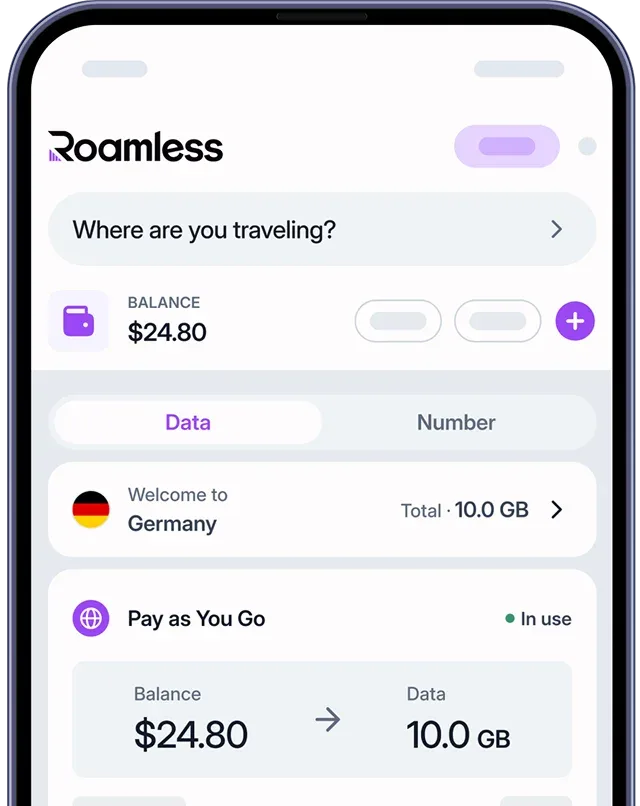
A Roamless global eSIM covers 200+ destinations, so you install it once and it keeps working as you cross borders. You can use Pay as You Go with Credits that never expire, or choose a fixed Data Plan if you’d rather know your costs up front. Phone numbers come separately with Roamless Numbers, so unless you add one, keep your home line on for calls and codes. Download Roamless before your next trip.
FAQ
If I use an eSIM, should I turn data roaming off?
Not on the eSIM. A travel eSIM connects through a local network under a roaming agreement, so data roaming has to stay on for that line. Turn data roaming off on your home line instead, which is where the carrier charges come from.
Is roaming more expensive than an eSIM?
Often, yes. A travel eSIM can cost less from your first day abroad, but that depends on your carrier's roaming rates and how much data you use. Verizon and AT&T both charge $12 a day, so a week costs $84 however little data you need. The exception is an EU line traveling inside the EU, where roaming is included, and plans like T-Mobile's higher tiers that bundle international data.
Is roaming better than using an eSIM?
It is better when you need your own number for calls and SMS, when your carrier's roaming rates are low, or when someone else pays the bill. An eSIM is better when a day pass costs more than the data you'd use, on multi-country routes and on anything data-heavy.
Will I still get my 2FA codes?
Only if your home line stays active. Travel eSIMs do not carry a phone number, so SMS codes go to your home number as usual. Keep that SIM switched on with data roaming off, or move the accounts that matter to an authenticator app before you leave.
Can I use an eSIM and my normal SIM at the same time?
Yes, on any dual SIM phone. Both lines stay registered, you pick which one carries data, and you can leave your home number as the default for calls.
Do I need a SIM card for international travel at all?
You need some way to get online. That can be your existing SIM with roaming switched on, a travel eSIM, a local SIM bought at the destination, or WiFi alone if your trip allows it. Check your phone supports eSIM before you plan around one.
Are travel eSIMs reliable?
They run on the same physical networks as any local SIM, so coverage is as good as the host network's. Where problems show up is in congestion, because some networks give priority to their own customers' traffic, and occasionally in network selection, which can need switching from automatic to manual on arrival.
Can I top up mid-trip?
With most providers, yes, provided you have a connection. Topping up an eSIM while abroad is straightforward, with the exception of markets like Türkiye where some provider apps are blocked locally.