Before using your phone in Germany, it’s important to check whether your device is compatible with local mobile networks. While many modern smartphones work without problems, some models may not support the network frequencies used by German carriers. Understanding how SIM cards and eSIMs work in Germany can also help you stay connected. This article explains what you need to know about phone compatibility, local operators, and available connectivity options.

Will My Cell Phone Work in Germany?
Yes, your cell phone will work in Germany if it is unlocked and supports the mobile frequencies used by German carriers. Germany uses GSM, 4G LTE, and 5G networks. Most modern smartphones are compatible, especially devices that support common LTE bands such as 3, 7, 8, 20, and 28, as well as widely used 5G bands like n1, n28, and n78. [1]
If your phone is locked to a specific carrier or does not support these bands, you may experience limited coverage or slower data speeds.
To stay connected, make sure your device can use a local SIM card or eSIM. Mobile coverage is generally reliable in cities and populated areas, with weaker signals possible in rural regions. Checking your phone’s technical specifications before traveling can help prevent connection issues.
Mobile Coverage Varies by Location in Germany
Your Phone Must Be Unlocked to Use Local Services
Wi-Fi Is Widely Available and Useful in Germany
Check That Your Phone Supports Germany’s Network Bands
Mobile service in Germany is generally reliable, but coverage can change depending on where you are. Large cities and densely populated areas usually have strong 4G LTE and growing 5G coverage. In rural regions, forests, or mountainous areas, signal strength may be weaker or less consistent.
Cities such as Berlin, Munich, Hamburg, and Frankfurt typically offer stable coverage across multiple networks. In smaller towns or remote areas, speeds may drop or indoor coverage may be limited. Coverage maps provided by German mobile operators or independent platforms can help you check signal availability in specific locations.
To use a German SIM card or eSIM, your phone needs to be unlocked. If your device is locked to your home carrier, it will not accept SIM cards from German providers, even if it supports the correct network bands.
On iPhones, you can check this by going to Settings > General > About > Carrier Lock. If it shows no SIM restrictions, the phone is unlocked. [2] On Android devices, inserting a SIM card from another carrier is usually the easiest way to confirm unlock status. Make sure this is sorted before traveling to avoid connection issues.
Public Wi-Fi is common in Germany, especially in hotels, cafés, airports, train stations, and shopping centers. It can be helpful when mobile coverage is weak or if you want to reduce mobile data use.
Many networks require accepting terms or logging in, and speeds can vary. For security, it’s better to use password-protected networks and avoid accessing sensitive accounts on open Wi-Fi connections.
Not all phones are guaranteed to work well in Germany, especially devices made for other regions. Your phone must support the frequency bands used by German mobile networks to get reliable service.
Germany commonly uses the following bands:
4G LTE: Bands 3 (1800 MHz), 7 (2600 MHz), 8 (900 MHz), 20 (800 MHz), and 28 (700 MHz)
5G: Bands n1, n28, n78, and n41 in selected areas
If your phone does not support these bands, it may connect only to slower networks or have limited coverage. Checking your device’s technical specifications before your trip helps ensure compatibility with German mobile networks.
How Do I Know if My Phone Will Work in Germany?
Before traveling to Germany, it’s important to confirm that your phone can connect properly to local mobile networks. Even though Germany uses widely adopted mobile standards, your device still needs to meet a few technical conditions. These include being unlocked, supporting common network technologies, and working with the frequency bands used by German carriers.
Carrier Restrictions
If your phone is locked to your current mobile provider, it may not accept a German SIM card or eSIM.
An unlocked phone allows you to use local mobile services or international plans while in Germany.
You can usually check your phone’s lock status in the device settings or by contacting your carrier directly.
Network Compatibility
Germany uses GSM-based mobile networks, including 4G LTE and expanding 5G coverage.
Most modern smartphones sold in Europe, North America, and many other regions support these standards.
It’s still recommended to confirm that your phone is designed to operate on European network technologies.
Frequency Bands
Your phone must support specific LTE and 5G frequency bands to connect reliably in Germany.
Missing support for key bands can result in slower speeds, limited coverage, or no service in some areas.
Band information can be found on your phone’s official specification page or trusted technology websites.
Common Mobile Frequency Bands in Germany
Below is a simplified overview of mobile frequency bands commonly used in Germany. Phones that support several of these LTE bands, and at least one 5G band, are generally compatible with German mobile networks.
Network Type | Frequency | Use Case |
|---|---|---|
LTE Band 3 | 1800 MHz | Main 4G band used nationwide |
LTE Band 7 | 2600 MHz | High-capacity LTE in urban areas |
LTE Band 8 | 900 MHz | Improved indoor and rural coverage |
LTE Band 20 | 800 MHz | Wide-area and rural LTE coverage |
LTE Band 28 | 700 MHz | Extended coverage and better signal reach |
5G n1 | 2100 MHz | Shared 4G/5G band in many areas |
5G n28 | 700 MHz | Low-band 5G for broader coverage |
5G n78 | 3500 MHz | Primary mid-band 5G for speed and capacity |
These bands are especially important if you plan to rely on mobile data for navigation, messaging, or local calls. Checking that your phone supports several of the main LTE bands and at least one widely used 5G band will help ensure reliable connectivity in Germany.
Cell Service in Germany
Cellular service in Germany is reliable and widely available, especially in cities and populated areas. The country is served by three main mobile network operators: Deutsche Telekom (Telekom), Vodafone Germany, and Telefónica Germany (O2). These providers offer extensive 4G LTE coverage nationwide and steadily expanding 5G networks.
Does T-Mobile work in Germany?
Yes, T-Mobile works in Germany through international roaming. Since T-Mobile uses GSM-based networks and Germany also operates on GSM, most T-Mobile phones can connect to German networks without technical issues. Many T-Mobile plans include roaming in Germany with reduced speeds, while higher-tier plans may offer faster data allowances. Coverage quality depends on the local partner network, which is typically Telekom or Vodafone Germany.
Does Verizon work in Germany?
Yes, Verizon works in Germany, but only through international roaming. Verizon phones that support GSM and LTE bands used in Europe can connect to German networks. Roaming charges and data limits depend on your Verizon plan, and some older Verizon devices may have limited compatibility. Service quality varies by location and local partner coverage.
Does AT&T work in Germany?
Yes, AT&T works in Germany via international roaming agreements. Most modern AT&T smartphones are compatible with German LTE and 5G networks. AT&T offers international day passes and roaming plans that allow voice, text, and data use in Germany. Network performance depends on the local carrier your phone connects to, commonly Telekom or Vodafone.
Germany Phone Code
Germany uses the international dialing code +49. Phone numbers typically begin with a city or mobile prefix, followed by the local number. When calling within Germany, the leading zero is used in area codes. For international calls, the zero is dropped.
International dialing format: +49 [area or mobile code] [local number]
From outside Germany, use +49 followed by the number without the leading zero
From within Germany, dial the full number including the leading zero
No additional international dialing steps are required when calling German numbers locally
This structure applies to both landline and mobile numbers across Germany.
Roamless eSIM for Germany
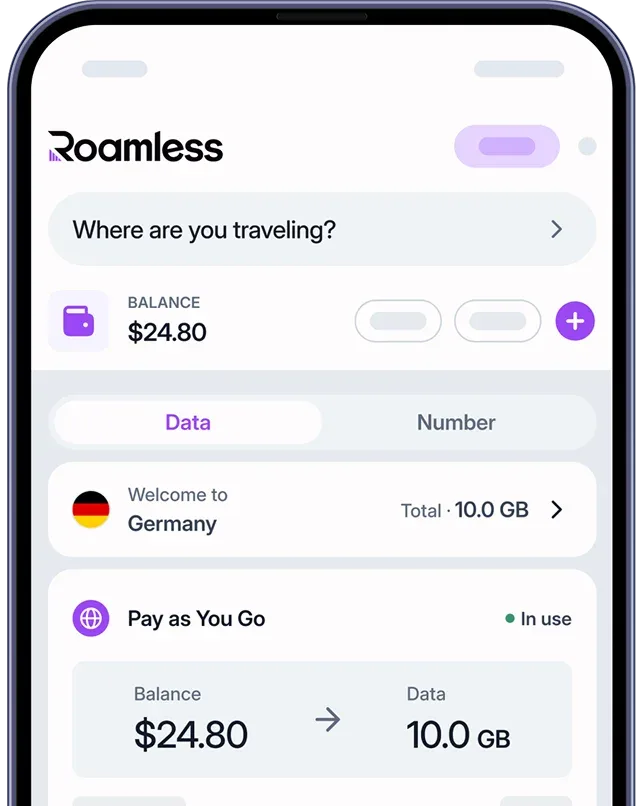
Using a global eSIM is a practical way to stay connected during your trip to Germany. Roamless allows travelers to activate mobile data directly on their phones without needing a physical SIM card. Setup is done through a QR code and does not require store visits or additional equipment.
Roamless follows a flexible pricing model with affordable data options for Germany. You can start with 1 GB for $3.95, or choose larger plans such as 2 GB for $5.95, 3 GB for $8.45, 5 GB for $10.95, and 10 GB for $15.95. All plans are valid for 30 days, do not require contracts, and allow you to use the data within the validity period. Data usage and remaining balance can be tracked easily through the Roamless app.
Key features of Roamless:
Pay only for the data you use with clear pricing
Quick activation via QR code
Mobile data access without relying on public Wi-Fi
One eSIM that works across multiple countries
For more details, you can visit our eSIM GermanyandeSIM Berlin pages.
Frequently Asked Questions
Do I need to turn on data roaming to use my phone in Germany?
Yes. To use mobile data in Germany with a roaming plan or an eSIM, data roaming must be enabled in your phone’s settings. This applies to both physical SIM cards and eSIMs and is required for the device to connect to local networks.
What should I do if my phone doesn’t connect after installing an eSIM in Germany?
Make sure mobile data is turned on and data roaming is enabled. If the connection still doesn’t work, restarting your phone or reinstalling the eSIM profile often fixes the issue. You can also check that the eSIM is set as the active data line in your device settings.
Can I use a German SIM or eSIM with my phone?
Yes, as long as your phone is unlocked and supports the network bands used in Germany. An unlocked device allows you to use local SIM cards or eSIMs, and services like Roamless can be a convenient alternative to traditional international roaming while keeping setup simple.
Sources:
[1] GSMArena. (n.d.). Network bands in Germany. https://m.gsmarena.com/network-bands.php3?sCountry=GERMANY
[2] Apple Support. (n.d.). How to check if your iPhone is unlocked. https://support.apple.com/en-us/HT201328