Staying connected in Thailand depends on how well your phone matches the country’s mobile networks. Thailand uses specific 4G and 5G bands, and not every device supports them, so checking this in advance helps you avoid weak signal or limited service. Local carriers offer broad coverage in major cities and tourist areas, while some rural regions may have fewer network options. Understanding these basics makes it easier to predict how your phone will perform during your trip.

Can I use My Phone in Thailand?
Yes, most mobile phones work in Thailand when they are unlocked and support the country’s main 4G and 5G frequency bands. Thailand operates on GSM-based networks, and the key 4G LTE bands include 700 MHz Band 28, 850 MHz Band 5, 900 MHz Band 8, 1800 MHz Band 3, 2100 MHz Band 1 and 2300 MHz Band 40. [1] For 5G service, the active bands are n41 at 2600 MHz, n28 at 700 MHz and n1 at 2100 MHz. Phones that include these bands connect well across cities, airports and major tourist areas. Ensuring the device is unlocked before travel allows it to register on local networks without restriction.
1. Make Sure the Phone Is Unlocked
To use a local SIM card or an eSIM in Thailand, the device needs to be unlocked. An unlocked phone accepts SIM cards from Thai operators such as AIS, True and dtac. Devices purchased directly from Apple, Samsung or Google are generally unlocked. If the phone was bought through a carrier, especially in the United States or the United Kingdom, it is useful to contact the carrier and request an unlock before traveling. The unlock status can also be checked in device settings. An unlocked phone allows the use of local networks and helps avoid high roaming costs.
2. Check Network Compatibility
Before using a phone in Thailand, it is important to confirm that it supports the frequency bands used by Thai carriers. Thailand operates on GSM-based networks, and the main 4G LTE bands in use are 700 MHz Band 28, 850 MHz Band 5, 900 MHz Band 8, 1800 MHz Band 3, 2100 MHz Band 1 and 2300 MHz Band 40. For 5G, the active bands include n41 at 2600 MHz, n28 at 700 MHz and n1 at 2100 MHz. Many recent smartphones from Europe, Asia and the United States already support these bands, but checking the device’s specifications ensures consistent coverage and dependable mobile data during the trip.
3. Understand Roaming and Data Plans
If you are traveling to Thailand with a SIM card from another country, roaming may lead to extra charges. Thailand is not part of any regional free-roaming system, so travelers should review their carrier’s roaming rules before using data or making calls.
For travelers from the United States, roaming fees generally follow these patterns:
AT&T charges $12/day with its International Day Pass, allowing talk, text and data use in Thailand.
T-Mobile Magenta plans include free texting and low-speed data in Thailand, but speeds around 128 kbps may not be suitable for navigation or media.
Verizon’s TravelPass costs $12/day, allowing the use of the customer’s domestic plan while in Thailand.
To avoid these daily fees and limited speeds, many visitors choose a local SIM card or an eSIM. Thai operators such as AIS, True and dtac offer prepaid plans starting around $8–$12, which typically include several gigabytes of data and provide coverage across major cities and tourist areas.
For more information you can read our page on eSIM Thailand,eSIM Phuket and eSIM Bangkok.
Use Public Wi-Fi for Basic Connectivity
For simple online needs such as checking maps, sending messages or browsing, public Wi-Fi is accessible in many parts of Thailand. Availability and speed can vary by location, but the following places regularly offer a connection:
Airports and transport hubs: Major airports like Suvarnabhumi and Don Mueang provide free Wi-Fi for visitors.
Hotels and guesthouses: Most accommodations include Wi-Fi in rooms and shared areas.
Cafés and restaurants: Many cafés and several restaurant chains offer complimentary internet for customers.
Public areas and malls: Large shopping centers and some tourist zones provide free Wi-Fi access.
How Do I Know if My Phone Will Work in Thailand
Carrier Restrictions
Some phones are locked to their original carrier and cannot use a Thai SIM or eSIM until the lock is removed.
Thailand does not have a rule that requires carriers to unlock devices after a certain period, so the process depends entirely on the policies of your home carrier.
To check whether a phone is unlocked, you can insert a SIM card from another network or review the network information in the device settings.
Many devices clearly display whether they accept SIM cards from other networks in the settings menu.
Network Compatibility
Mobile networks in Thailand operate on GSM, UMTS, LTE and 5G technologies.
For 5G, the important bands are n28 at 700 MHz, n41 at 2600 MHz and n1 at 2100 MHz.
A phone that supports these bands can generally connect reliably in major cities and popular travel areas.
Frequency Bands in Thailand
Network Type | Frequency Bands | What It Means in Thailand |
|---|---|---|
GSM (2G) | 900, 1800 MHz | Legacy network active in limited areas and used as secondary coverage |
UMTS (3G) | 850, 900, 2100 MHz | Provides voice and fallback data; gradually being phased out |
LTE (4G) | 700, 850, 900, 1800, 2100, 2300 MHz | Wide 4G availability across cities and major tourist regions |
5G NR | n28 (700 MHz), n1 (2100 MHz), n41 (2600 MHz) | Extensive 5G presence in major urban centers and transport hubs |
A phone that supports these frequency bands and is unlocked will operate reliably on Thai networks in most populated and traveler-friendly regions.
Cell Service in Thailand
Thailand’s mobile network is well-developed and offers broad coverage in major cities, towns and popular travel destinations. Local carriers including AIS, True and dtac provide extensive 4G LTE service throughout the country and continue to expand 5G availability in urban areas such as Bangkok, Chiang Mai, Pattaya and Phuket. Internet access in Thailand is open, and common services like Google, WhatsApp and social media platforms function normally. Some public Wi-Fi networks, especially in airports, malls or cafés, may ask users to register with a phone number or email address before connecting.
Does AT&T work in Thailand
Yes, AT&T offers international roaming in Thailand through its International Day Pass, which costs $12/day. This option allows travelers to use their regular plan from the United States, including data, calls and texts, while connected to Thai networks. Charges apply only on the days the phone is used abroad. In Thailand, AT&T customers typically connect to major carriers such as AIS, True or dtac, all of which provide strong 4G coverage and growing 5G availability in large cities. It is a practical choice for travelers who want to stay connected without switching SIM cards.
Does Verizon work in Thailand
Yes, Verizon’s TravelPass also functions in Thailand at a rate of $12/day, giving access to the user’s domestic plan. Verizon partners with Thai operators like AIS and True, providing reliable LTE performance in areas such as Bangkok, Phuket, Chiang Mai and Pattaya. In locations with 5G deployment, some travelers may also experience 5G connectivity. While the service is convenient, the daily fee can become expensive during longer trips.
Does T-Mobile work in Thailand
Yes, T-Mobile’s Magenta and Magenta Max plans include international texting and data in Thailand, but data speeds are typically limited to 2G-level performance of about 128 kbps. This is suitable for simple tasks such as messaging or checking light webpages but may not be adequate for map navigation or media-heavy use. To access faster data, T-Mobile offers International Passes, starting at $5/day for a small high-speed data allowance. In Thailand, T-Mobile users generally connect to AIS, True or dtac, which have wide network coverage in urban and tourist areas.
Thailand Phone Number Format
Thailand’s phone number structure is straightforward for both domestic and international dialing.
Country code: +66
Mobile numbers: Begin with 06, 08 or 09. When calling internationally, the initial 0 is removed, and mobile numbers contain 9 digits after the country code.
Landline numbers: Start with 0, followed by a 1- or 2-digit area code, depending on the region. For international calls, the leading 0 is removed.
Trunk code rule: The 0 at the beginning of both mobile and landline numbers is only used within Thailand. It is not included when dialing from outside the country.
Roamless eSIM: A Smart Way to Stay Connected in Thailand
A global eSIM is a practical option for travelers visiting Thailand who want dependable mobile data without handling a physical SIM card. It is especially convenient for those moving between different regions of the country or continuing their trip across Asia.
Key features of using Roamless eSIM in Thailand:
Easy activation through a QR code or the Roamless mobile app.
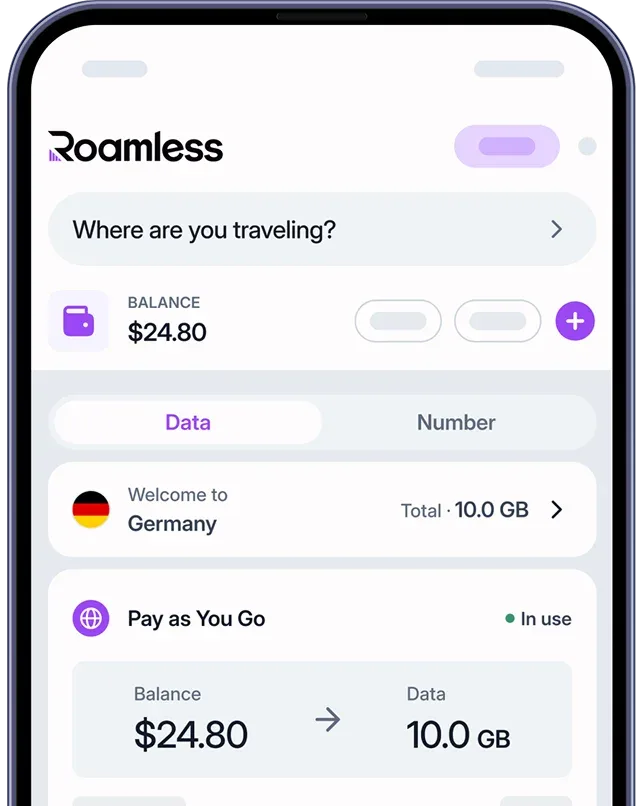
Pay-as-you-go data at competitive rates: 1 GB for $2.45, 3 GB for $7.35, 5 GB for $12.25, and 10 GB for $24.50.
Includes 500 MB of free trial data with no time limit to activate it.
Supports fast networks in Thailand, including areas with 5G availability.
Hotspot sharing is supported on compatible devices.
No expiration on unused data, giving full flexibility for short or extended stays.
If your phone is unlocked and supports the network bands used in Thailand, it will connect without difficulty. While your home carrier’s roaming service may work, daily international fees can increase costs quickly. Choosing a travel eSIM such as Roamless offers a more cost-effective solution with quick setup, affordable data, and solid coverage across Thailand.
In addition, You can open the Roamless app and enter a valid promo code at checkout. To get the latest offers and extra data on your first purchase, visit our eSIM promo code page.
Frequently Asked Questions
Do I need to unlock my phone to use a Thai SIM or eSIM?
Yes. A locked phone cannot register on Thai networks. Make sure your device is unlocked by your home carrier before arriving in Thailand.
Which mobile networks operate in Thailand?
The major carriers are AIS, True and dtac. All provide widespread 4G LTE coverage and expanding 5G service in major cities and tourist destinations.
Can I use my US carrier (AT&T, Verizon, T-Mobile) in Thailand?
They offer roaming in Thailand, but daily fees apply. AT&T and Verizon charge $12/day, while T-Mobile provides low-speed data unless an International Pass is purchased. Many travelers prefer a local SIM or eSIM to reduce costs.
Are eSIMs available in Thailand?
Yes. Travelers can use global providers like Roamless or purchase a local eSIM from Thai carriers. eSIMs are convenient for quick activation and work well if the phone supports eSIM technology and Thailand’s network bands.
Source:
[1] GSMArena. (n.d.). Thailand network bands. https://www.gsmarena.com/network-bands.php3?sCountry=Thailand