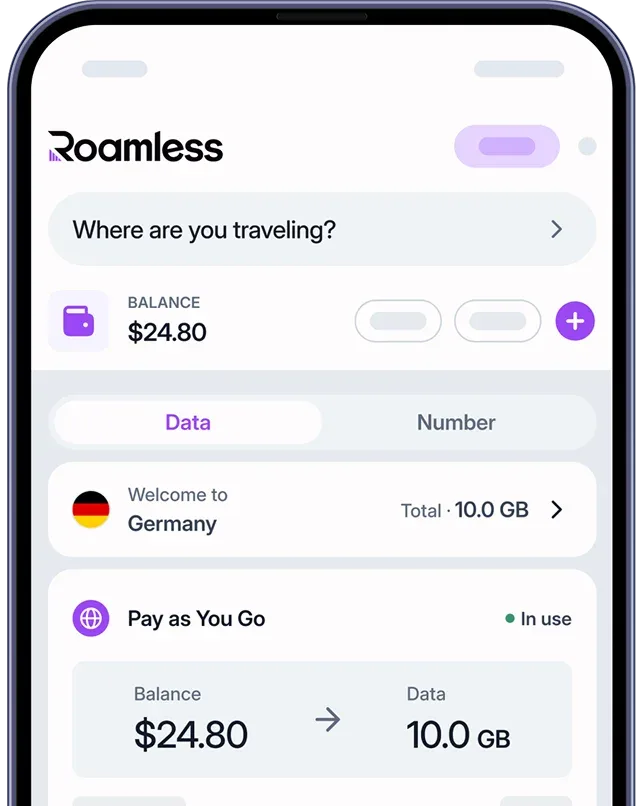
Keeping your phone connected in Germany supports trip planning, directions, and general communication. This guide explains the SIM card options available to visitors and shows how to choose a provider, data plan, and setup that fit your travel requirements.

Germany Travel SIM Cards
Travel SIM cards in Germany are designed for international visitors and give mobile data access without requiring a long-term contract. These SIMs commonly offer:
Data-only options or data with calls and texts
Short-term validity periods, often from 7 to 30 days
Easy activation, with most phones connecting right away
Before choosing a SIM card, consider how much data you’ll need, how long you’ll stay, and your overall budget. German providers offer a wide range of plans, from smaller packages around 3–5 GB to larger or high-usage options.
Make sure your phone is unlocked and supports European network bands. Germany uses 4G LTE bands such as 1, 3, 7, 8, 20, 28, 32, and 38. For 5G, common bands include n1, n3, n28, and n78. [1]
For visitors who don’t want to use a physical SIM card, an eSIM is another option. You can also check our eSIM Germany page and read our guides on the best eSIM for Germany and roaming charges in Germany to compare available choices.
Prepaid SIM Cards for Germany
Prepaid SIM cards are a convenient option for international visitors traveling to Germany. These pay-as-you-go plans let you buy mobile service in advance with a set amount of data, calls, and texts that stays active for a specific number of days. They work well for travelers who want to manage costs, avoid roaming fees, or only need service for part of their stay.
Major German mobile providers such as Telekom, Vodafone, and O2 offer prepaid plans. These options do not require contracts, credit checks, or long-term commitments. You can buy them online before your trip, at airports, or in stores after you arrive, including supermarkets and electronics shops. Many prepaid plans are available as physical SIM cards or eSIMs, making them suitable for most modern phones.
Germany Mobile Data Plans for Tourists
Mobile data plans in Germany are available for both short-term visitors and those staying for several weeks. You can choose a plan that matches how long you’ll be in the country and how much data you expect to use.
For short trips, a 7-day plan with a few gigabytes of high-speed data is usually enough for navigation, messaging, browsing, and light social media use. For longer stays, 15-day or 30-day plans with larger data amounts are common. Some providers include features like hotspot use at no extra cost. When choosing a plan, think about your daily data needs and whether you’ll rely on hotel or public Wi-Fi during your stay.
While physical SIM cards have long been used by international visitors in Germany, a global eSIM like Roamless offers a newer and easier way to get connected without visiting a store. eSIMs provide several advantages that make them simpler to use than traditional SIM cards:
Set up in advance: Install your eSIM before leaving home and connect as soon as you arrive in Germany.
Skip in-person purchases: No need to stop at airport stands or stores, since activation is fully digital.
Adjustable plan choices: Change plans or add data directly through your phone while traveling.
Keep your SIM tray available: Your physical SIM stays in the device, so you can still use your home number if needed.
Less plastic waste: eSIMs remove the need for physical cards and extra packaging.
Modern device support: Most newer smartphones work with eSIM technology, which is becoming standard worldwide.
Arriving with an active eSIM means you can start using maps, messaging apps, and online tools immediately. For travelers who want quick and dependable mobile data with minimal effort, a travel eSIM is an easy and convenient option.
For detailed information about eSIMs, you can read our post on What is eSIM and how does it work to understand the basics.
Best SIM Cards for Germany Travel
If you're visiting Germany, having mobile data makes navigation and communication much easier. Prepaid SIM cards are a popular option for international travelers who want clear pricing without contracts. Both physical SIM cards and eSIMs are available, and several providers offer plans suitable for short visits or longer stays. The table below gives an overview of some commonly used options for tourists in Germany.
Provider | Data & Calling | Key Features | Convenience |
|---|---|---|---|
Telekom | Data, calls, texts | Wide national coverage; fast speeds; 5G available; SIM + eSIM | Easy to buy in shops and supermarkets |
Vodafone | Data, calls, texts | Strong performance; 5G support; SIM + eSIM | Available across Germany in many retail stores |
O2 | Data-focused plans with calls/texts | Budget-friendly; good coverage in cities; SIM + eSIM | Simple activation; suitable for longer trips |
Roamless (eSIM) | Pay-as-you-go data; international calls via app; no expiry | eSIM only; 5G supported; activate digitally | No store visit needed; set up before arrival |
Each provider offers different plan types, so the best choice depends on your device, the length of your stay, and how much data you expect to use. Roamless is helpful for travelers who want an eSIM ready before they arrive, while Telekom, Vodafone, and O2 offer physical SIM cards and eSIMs with broad national coverage.
Germany SIM Cards: What to Look For
When choosing a SIM card for your trip to Germany, it’s useful to keep a few key points in mind.
Data allowance: Plans range from small options like 3–5 GB to larger or high-usage packages.
Validity period: Most tourist-friendly plans last 7, 15, or 28–30 days.
Network coverage: Service is provided through major networks such as Telekom, Vodafone, and O2.
Extra features: Some plans include hotspot use or basic international calling.
Pricing: Costs depend on data size and duration. Typical prepaid plans range from €10 to €30 or more.
For example, a 10 GB plan valid for 28–30 days may cost around €15–€20, while larger data packages or 5G-enabled plans can be higher. Some unlimited-style plans reduce speeds after a certain amount of high-speed data, so it’s worth checking the details.
While physical SIM cards are easy to buy across Germany, a global eSIM like Roamless offer more flexibility for travelers.
You can activate the eSIM before arriving in Germany.
No need to visit a store or stand in airport lines.
You can change or add data plans directly from your device.
Your phone’s SIM tray stays free for your home SIM.
eSIMs reduce unnecessary plastic waste.
Most new smartphones support eSIM technology.
With an eSIM ready before you land, you can get online immediately for maps, transport apps, and messaging. For many visitors, an eSIM provides a simple and dependable way to stay connected in Germany.
Germany SIM Card Costs
The price of prepaid SIM cards in Germany depends on how much data you need, how long the plan lasts, and which provider you choose. Here’s a simple overview to help estimate your mobile data costs while traveling:
Provider | Plan Type | Data & Pricing | Ideal For |
|---|---|---|---|
Telekom | Short to Long-term (28 days) | 3 GB to 15 GB / €10 to €20 | Travelers wanting strong nationwide coverage |
Vodafone | Short to Long-term (28 days) | 4 GB to 20 GB / €10 to €25 | Users seeking solid coverage and good speeds |
O2 | Short to Long-term (28 days) | 5 GB to 30 GB / €8 to €20 | Budget-conscious visitors needing more data |
Roamless (eSIM) | Short to Long-term | 1 GB to 10 GB / $3.95 to $22.95 | eSIM users wanting flexible setup before arrival |
These ranges reflect typical German prepaid prices, which are usually more affordable than in many other destinations. Comparing coverage, data size, and trip length can help you choose the most suitable option.
How to Buy SIM Cards in Germany
Germany offers several easy ways for travelers to purchase a SIM card, whether you prefer arranging everything before departure or picking one up after you arrive.
Pre-order online: You can purchase a prepaid SIM or eSIM before your trip and complete most of the setup in advance.
Buy at the airport: Some German airports may have shops or kiosks that sell SIM cards, though availability can vary by terminal and time of day.
Visit supermarkets: Large supermarket chains such as Aldi, Lidl, and Rewe often sell prepaid SIM cards, but stock and models can differ by location.
Go to electronics shops: Electronics retailers like MediaMarkt and Saturn commonly offer SIM cards from various providers, depending on the store.
Buy from carrier stores: Telekom, Vodafone, and O2 shops across Germany provide prepaid plans, with availability depending on the specific branch.
For prepaid SIM cards in Germany, ID verification is required. You’ll need to show your passport during activation, either in-store or through an online video process. Make sure your phone is unlocked and compatible with European network bands to avoid issues.
Physical SIM cards are easy to find throughout the country, but eSIMs offer a more convenient option. You can buy an eSIM online, set it up before your flight, and arrive in Germany with instant mobile data access. This helps you skip store visits and saves time after a long journey.
eSIMs: A Digital Alternative to Physical SIMs
eSIMs give travelers an easy way to stay connected in Germany, offering several benefits compared to regular physical SIM cards.
Instant activation: Purchase and activate your plan before flying, so you’re online the moment you land.
Multiple profiles: Keep your main number active while using a German data plan on the same device.
No physical swapping: Skip inserting or carrying small SIM cards during your trip.
Environmental benefit: A digital option that helps reduce plastic waste.
For travelers with eSIM-compatible devices, this technology offers a smooth and flexible way to get mobile data in Germany without visiting a store or handling physical SIM packaging.
SIM Card, Pocket WiFi, or eSIM for Germany?
If you're traveling to Germany, you can stay connected through Pocket WiFi, a physical SIM card, or an eSIM. Each option suits different travel styles.
Pocket WiFi
Connects multiple devices at the same time
Offers stable internet in most cities
Requires carrying and charging an extra device
SIM Cards
Work directly in an unlocked phone for calls and data
Usually affordable for longer stays
Limited to one device at a time
eSIMs
Can be activated online before you arrive
Keep your home number active while using German data
Only available on eSIM-compatible devices
Will my phone work in Germany?
Most modern, unlocked smartphones work without problems on German mobile networks, especially if they support 4G LTE and 5G. Before your trip, it’s a good idea to check whether your device supports the frequency bands used in Germany. Using a local prepaid SIM or an eSIM can help you avoid high roaming charges and enjoy stable coverage throughout your stay. Whether you’re exploring major cities like Berlin or visiting quieter towns, these options make it easy to stay connected.
Germany SIM Card: Berlin Airport (BER)
Berlin Brandenburg Airport has a limited number of places where travelers may be able to purchase a prepaid SIM card after arrival. The most consistent option is a shop in the arrivals area that sells tourist SIM cards. Availability depends on opening hours, and the range of plans is usually smaller than what you can find in the city. In some cases, other shops within the terminal may also sell SIM cards, but this can vary.
Airport purchases are convenient, though prices are often higher and plan choices more restricted compared with city stores. Activation is typically done by the user and includes the required ID verification process for prepaid SIM cards in Germany.
Many visitors choose to set up a travel eSIM before flying to Berlin. An eSIM can be activated online and used immediately after landing, avoiding the need to look for a shop at the airport.
You can also check our guide on Berlin Airport WiFi for information on getting online while still inside the terminal.
Germany SIM Card: Frankfurt Airport (FRA)
Frankfurt Airport, one of Europe’s busiest hubs, has several shops and convenience stores where travelers may find prepaid SIM cards. Availability can vary by terminal, but some stores in Terminal 1 and Terminal 2 offer SIM options from different mobile providers.
As with most airports, prices at FRA can be higher, and the selection more limited than in the city. Activation typically requires inserting the SIM and completing passport verification on your device.
Setting up a travel eSIM before flying is often more practical. Once installed, you can connect to mobile data as soon as you arrive, without needing to find a store.
You can also read our guide on Frankfurt Airport WiFi for details on staying online right after landing.
SIM Card for Berlin
Berlin’s size and varied districts make reliable mobile access important for visitors. When selecting a SIM card for the city, it is useful to consider signal coverage, data speed, and where the SIM can be purchased.
Coverage should work well in central areas such as Mitte, Kreuzberg, Charlottenburg, and Friedrichshain
Data speeds should support navigation, public transport apps, and general online use
SIM cards are available in supermarkets, electronics stores, carrier shops, and online
Telekom, Vodafone, and O2 provide service across most of Berlin, with generally consistent network performance. Reviewing recent user reports can help identify which provider offers the most suitable coverage in the districts you plan to visit.
For more details, you can also visit oureSIM Berlinpage.
Choosing the right SIM or eSIM makes it easier to stay connected during your trip. Whether you purchase a prepaid SIM after landing or activate an eSIM in advance, select the option that matches your device and data requirements for steady and dependable service.
Frequently Asked Questions
Can you buy a SIM card without a plan in Germany?
Yes, you can buy a SIM card without a plan, but it must be activated and topped up before use. Germany requires ID verification for prepaid SIM activation, so you will need to complete this step before adding credit or choosing a plan.
Where can I buy a SIM card in Germany?
SIM cards are available at airports, supermarkets, electronics shops, mobile carrier stores, and online sellers. Buying in the city or activating an eSIM before arrival often provides more options and better prices.
How do I activate a SIM card or eSIM in Germany?
Activation usually involves inserting the SIM and completing ID verification through an in-store process or online video check. For eSIMs, activation is done digitally by scanning a QR code and following the instructions provided by the carrier.
Can I use an eSIM in Germany?
Yes, most recent smartphones support eSIM technology, and major German providers offer eSIM plans. Setting up an eSIM before your trip allows you to connect to mobile data immediately after landing.
Do I need to show ID to buy a SIM card in Germany?
Yes, ID verification is required for all prepaid SIM cards. A passport or official ID must be used during the activation process.
Source:
[1] GSMArena.Germany network bands. https://www.gsmarena.com/network-bands.php3?sCountry=Germany